 The Joy of Cryptography
One-Time Pad and the Provable Security Mindset
Every cryptography story begins the same way: Alice wants to send a message to Bob. This would be an easy task if it weren't for Eve, who eavesdrops on their conversation.
1.1. Defining the problem
Alice (she/her) has a message , called the plaintext, that she wants to send privately to Bob (he/him). She uses an encryption procedure, which we call , to transform the plaintext into a ciphertext , which she can send to Bob. When Bob receives , he runs a decryption algorithm to recover the original plaintext.

Security is all about what can/can't happen in the presence of an attacker, usually referred to as the adversary. For now, let's consider an eavesdropping adversary—traditionally called Eve (she/her)—who observes the ciphertext during transit. Bob must know something that Eve does not: Otherwise, Eve would be able to do everything Bob can do, including decrypt the ciphertext. Some information about the decryption process must be secret, known to Bob but not Eve. But what exactly should be kept secret?
It's important to understand the difference between two similar-sounding questions:
-
What should be kept secret in a real-world scenario? The more information you can keep from the adversary, the harder it is to attack. So if you have an opportunity to hide more information about the encryption/decryption methods, why not take it?
-
What must be kept secret in order to prove a security guarantee? Every piece of information that must be secret is an assumption, a limit on the real-world relevance of our encryption method. Given the choice, wouldn't you prefer an encryption method whose security makes the fewest possible assumptions about what is kept secret from the adversary?
Naïve way of thinking about secrecy: For thousands of years, cryptography was based on the secrecy of the and algorithms themselves. There is nothing wrong in principle with making the encryption/decryption methods secret, but it's not ideal to base all your security guarantees on their secrecy.
-
If encryption/decryption algorithms are required to be secret, and one hundred pairs of people want to send private messages, then they will need to invent one hundred sufficiently different but equivalently secure encryption methods. This level of cleverness doesn't scale well.
-
If encryption/decryption algorithms are required to be secret, and the algorithms somehow fall into the adversary's hands, then it becomes necessary to redesign a new and sufficiently different method. It is difficult to keep algorithms secret, and easier to keep data secret.
-
If encryption/decryption algorithms are required to be secret, how can we subject anyone's encryption method to scientific scrutiny? How can we develop a consensus about what makes for a good encryption method? Scientific consensus is an inherently public process.
Modern way of thinking about secrecy: These days, we partition the encryption process into secret and nonsecret parts. The secret part is called the key: It is a piece of data that is provided as input to both the encryption and decryption algorithms. Ideally the key is short, so it's easy to generate, store secretly, and replace if necessary.
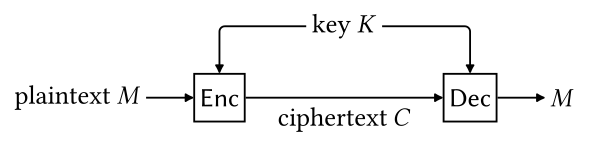
The key is the only thing assumed to be secret. The encryption/decryption algorithms themselves do not need to be secret, and their security guarantees should apply even if the adversary knows these algorithms.
The nineteenth-century cryptographer Auguste Kerckhoffs was the first to clearly articulate the idea that encryption methods should remain public. We still refer to the idea by his name:
“Il faut qu'il n'exige pas le secret, et qu'il puisse
sans inconvénient tomber entre les mains de l'ennemi.”
Literal translation: [The encryption method] must not require secrecy, and it should be able to fall into the enemy's hands without causing inconvenience.
Modern interpretation: Design your system to be secure even if the adversary has complete knowledge of all its algorithms, and so that all security properties stem ultimately from the secrecy of the key alone.
Remember: Kerckhoffs's principle doesn't say that you must make the algorithms public; it says that the system should be secure even if the algorithms are public.
1.2. One-time pad
The set of -bit strings is written as . The xor (exclusive-or) operation is written as . The concatenation of strings and is written as . See section A.1 for a review.
One-time pad (OTP) is the oldest and simplest encryption method that we'll encounter in this book. The keys, plaintexts, and ciphertexts in OTP are each -bit strings. The value can be any positive integer, and it can be known to the adversary. The encryption and decryption algorithms of OTP are as simple as it gets: Just xor the plaintext or ciphertext with the key. We can write these algorithms formally:
One-time pad (OTP) consists of the following two algorithms:
The values , , and are each -bit strings, for some positive integer .
Encrypting the following 20-bit plaintext under the 20-bit key using OTP results in the ciphertext below:
Decrypting the resulting ciphertext with the same key results in the original plaintext:
In order for OTP to be useful as a communication tool, the receiver should recover the intended plaintext when decrypting.
For all positive and all , we have .
We can substitute the definitions of OTP and , then apply the algebraic properties of xor. For all , we have:
The key for OTP must be sampled from the uniform distribution (sampled “uniformly at random”). More precisely, when the key is sampled uniformly, we can actually prove something about the security of OTP.
If is a set of items, then the uniform distribution over assigns probability to each item .
We write in pseudocode to mean that is sampled from the uniform distribution over .
In OTP, the key is sampled from the uniform distribution over . Each string is chosen with equal probability . We write the process of choosing a OTP key as .
1.3. How to formalize an attack scenario
In cryptography we prove things like, when you use this cryptographic algorithm in exactly this way, and the adversary has these capabilities, then you can expect this particular guarantee to hold. We can reason formally about such things using an attack scenario—a precisely defined interaction between one or more victims and an adversary—that specifies: (1) the “correct” usage of the cryptographic algorithms for the victim, and (2) the precise capabilities of the adversary. In this section, we discuss how to formalize an attack scenario for OTP; then in the next section, we will prove a security guarantee that holds in that scenario.
The encryption algorithm of OTP has two inputs and one output:
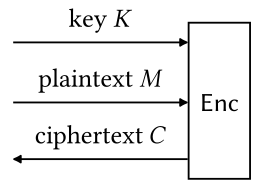
Our attack scenario assigns the victim and adversary to different parts of this interface.
-
The victim is responsible for choosing the key.
-
The adversary is responsible for choosing the plaintext input.
-
The adversary receives the ciphertext output.
The attack scenario fully prescribes what the victim “should” do. In our OTP attack scenario, the victim is expected to sample the key uniformly at random and use each key to encrypt only a single ciphertext. Our security proof for OTP relies on the fact that the key is chosen in precisely this way. If a real-world application doesn't involve a uniformly sampled key, then the security proof may not apply and its guarantee may not hold.
The behavior of the adversary is arbitrary and unspecified. Assigning the adversary to part of the OTP raw interface is our way of saying that there are no assumptions on how this part of the interface is used. There are no restrictions on how the plaintext input to is chosen, in the sense that the security proof does not assume anything about how it is chosen (subject to some subtlety, mentioned in section 1.6). There are no restrictions on what kinds of computations can be done on the ciphertext output.
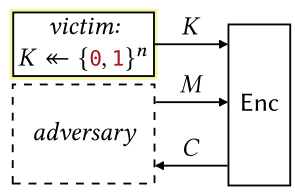
We can express the attack scenario even more precisely if we focus exclusively on the adversary's view of the interaction. The adversary is an arbitrary program that can invoke the following subroutine:
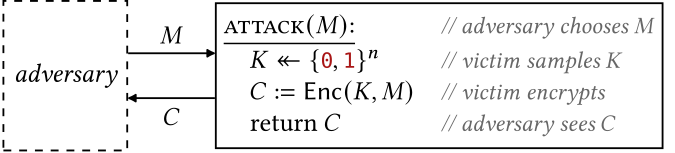
Everything about the attack scenario is captured in the code of this single subroutine. By inspecting this subroutine, you can see that the calling program (adversary) can choose the input and see the output but has no control over since it is sampled inside the subroutine. This reflects the fact that the attack scenario fixes the victim's behavior; the adversary cannot influence it.
Here are two more important things to keep in mind when interpreting the code of the attack scenario:
-
Even though OTP's algorithm is deterministic, this attack subroutine is randomized: Calling it twice, even on the same input, may give different results. This is because the victim samples a fresh key for each encryption, making its overall behavior randomized.
-
The variable is privately scoped to this subroutine. The calling program cannot see ; it sees only the subroutine's explicit return value .
Remember, the attack subroutine is not a description of the adversary's behavior, but rather the description of everything in the attack scenario except the adversary. The adversary is some unspecified algorithm that gets to call this subroutine on inputs of its choice and see the resulting output.
When we prove a security guarantee in the next section, we will prove what is/isn't possible by calling this attack subroutine. You can interpret such a proof as saying,
If I use OTP according to the attack scenario (i.e., I sample keys uniformly and use each key to encrypt just one ciphertext), then no matter how the plaintexts are chosen, and no matter how the ciphertext is subsequently used, I can enjoy a certain security guarantee.
We will use subroutines of this kind to reason about all security properties throughout the rest of the book.
General Mindset For Understanding Attack Scenarios: Every security definition in this book involves some kind of attack scenario. With practice, you will get more comfortable understanding them and interpreting their guarantees.
The victim always controls the secret key material and is responsible for running the cryptographic algorithms as specified. Secret keys are privately scoped to the attack scenario subroutine, which reflects Kerckhoffs's principle that security stems from secrecy of the key. But in OTP, security stems from not just the secrecy of the key but also the fact that a new key is sampled for each encryption. We might revise Kerckhoffs's principle slightly:
Design your system so that all security properties stem from the users correctly managing the secret keys.
“Correct key management” means different things in different attack scenarios. To understand what it means for a particular cryptographic algorithm, we just need to consult the source code of the attack scenario subroutine, since that's where the victim's behavior is prescribed. As a user of cryptography, you can enjoy the resulting security guarantee as long as you ensure that the keys are being managed in precisely this way.
Cryptography is a tool for turning things into key management problems.
— Lea Kissner
Besides the secret key input, the other inputs and outputs of cryptographic algorithms are generally left at the mercy of the adversary, and they become the adversary's interface to the attack scenario. Letting the adversary choose an input is the worst case; letting the adversary see an output is the worst case. As cryptographers, we strive to build things that are secure even in the worst case!
When an attack scenario allows the adversary to choose a value, we are saying that we want security to hold no matter how those values are chosen.
When an attack scenario allows the adversary to see a value, we are saying that we want security to hold no matter how those values are used elsewhere.
1.4. How to define and prove security of OTP
Now that we have characterized an attack scenario as a subroutine, what do we do with it? You might be expecting us to formalize explicit goals for the adversary. For example, the adversary can't find the plaintext, or the adversary can't recover the secret key. These bad outcomes are important to consider, but they are not how we formalize what it means to be “secure.”
Instead, we will consider something to be “secure” if the adversary sees only “random junk” in the attack scenario. More precisely, our goal will be to prove that the adversary sees uniformly distributed values. (The uniform distribution is the randomest junk there is!) Applying this principle to our attack scenario for OTP, we formulate security as follows:
For all positive integers and all choices of plaintext , the output of the following subroutine is uniformly distributed:
Recall what it means for something to follow the uniform distribution: Every outcome is equally likely. In this case, the outcome is the -bit return value of the attack subroutine. There are possible outcomes, so each one should happen with probability , regardless of the choice of .
Probabilities are written as . For a review of probability, see section A.2.
Before proving the claim in general (for all and all ), let's develop some intuition by looking closely at one concrete example. Let's consider and . What happens when is called?
There are four outputs possible: , , , and , each with probability 1/4. Thus, the output is distributed uniformly in .
There is nothing particularly special about in this example. The output of is uniformly distributed for any , which we now prove:
Fix arbitrary values . We are interested in , the probability that calling with plaintext input results in ciphertext output . That event happens exactly when
Applying the algebraic properties of xor, this condition is equivalent to:
In other words, there is only one choice of (namely, ) that causes to happen. Since is chosen uniformly from , the probability of choosing that one particular value is .
In summary, for any , we have . Thus, for any , the output of is uniformly distributed.
1.5. How to interpret a security proof
Even if you followed all the steps of this proof, you probably still have a lot of questions about what this proof means.
We proved something about the output of some subroutine. What does any of this have to do with security?
We designed the attack subroutine to formalize a specific, realistic attack scenario.
We proved something about this subroutine's output, which is what the adversary sees in the attack scenario.
Why is it desirable to prove that the output is uniformly distributed?
This is a theme throughout the book: Our security goal is to ensure that “the adversary should see only random junk.”
In fact, the attack subroutine behaves exactly identically to the following:
But this subroutine completely ignores , and its output has literally nothing to do with . Imagine Alice and Bob exchanging OTP ciphertexts. From the adversary's point of view, they might as well just exchange “decoy” values that were chosen uniformly, which have nothing to do with their intended plaintexts—the effect on the adversary would be the same. This adversary can't tell the difference between a world where Alice and Bob use OTP as intended, and a world in which they exchange literally meaningless junk.
What do you mean, the plaintext doesn't affect how the ciphertext is distributed? Bob is able to decrypt the ciphertext to recover the plaintext!
These facts are not contradictory; they simply involve different perspectives.
From the adversary's perspective (which doesn't include the key), the ciphertext is uniformly distributed.
From Bob's perspective (which includes both the ciphertext and the key), the ciphertext doesn't look uniformly distributed.
Using the more technical terminology of probability: The random variables and are correlated. Each of them is uniformly distributed when taken in isolation—that is, the marginal distributions of and are uniform. The joint distribution of and together is not uniform; it is a different distribution for different choices of . Exercise 1.10 explores Bob's perspective of this joint distribution.
When I use OTP, do I have to let the adversary choose my plaintexts? What does it mean for encryption to be secure against an adversary who already knows the plaintext?
Putting the adversary in charge of plaintexts is how our attack scenario reflects the worst case.
If OTP is secure even when the adversary chooses the plaintext, then of course it is also secure in your real-world system, where the adversary might have less influence over the choice of plaintext.
Why don't we just consider a scenario in which the adversary has no control over the plaintexts?
This kind of scenario would lead to security claims that aren't particularly interesting or useful.
Instead of proving “OTP is safe as long as its key is handled correctly," we could only prove “OTP is safe as long as its key is handled correctly and we are absolutely sure that no one else has had any influence over the choice of plaintexts."
In the real world, we often encrypt things in response to outside stimuli, so the outside world almost always has some influence over what is being encrypted.
How is Kerckhoffs's principle reflected in what we proved?
Kerckhoffs's principle is about deriving security from the secrecy of the key alone.
In our way of formalizing attack scenarios, the secrecy of values is reflected in their scope.
In the attack subroutine, the key is secret because the variable exists in a private scope.
It is not visible to the adversary; only the designated return value of attack is.
Kerckhoffs's principle is also about assuming that the adversary knows the details of the cryptographic algorithms. Knowing the source code of the attack subroutine doesn't change the fact that its output is distributed uniformly.
OTP consists of two algorithms, and , but the attack scenario only refers to . Doesn't have any bearing on security?
This is an astute observation.
has no bearing on this particular security property, but it is reasonable to also study other security properties.
Chapter 9 explores a more demanding attack scenario involving both and .
If the OTP key is chosen uniformly and independently for each encryption, and kept secret from the adversary, then ciphertexts appear uniformly distributed no matter how the plaintexts are chosen.
1.6. Limitations of security proofs
It's amazing that we can prove anything at all about security! But it's also important to maintain some humility and perspective.
Cryptography cannot address every important security aspect of a real-world system. OTP doesn't attempt to address any of the following questions, even though they are all important to the problem of private communication:
-
How can Alice and Bob obtain a secret key known only to them?
-
How can they keep secret?
-
How can a computer sample from the uniform distribution?
-
How can Alice ensure that is sent reliably to Bob?
-
How can Alice hide the fact that she is talking to Bob (rather than hide only the content of her messages)?
-
How can Alice be sure that she is communicating with Bob, not an impostor?
-
How can we incentivize Alice and Bob to use encryption?
-
Should the government be allowed to obtain a warrant to read Alice and Bob's encrypted communications?
-
and so on
For now, we have addressed only the following, much narrower question, which I hope you agree is still nontrivial:
Assuming that Alice and Bob (somehow) share a uniformly sampled key, known only to them, and they have the ability to exchange public messages, how can they communicate privately?
A security proof is a guarantee that holds only within one specific attack scenario. The adversaries in our security proofs always “play by the rules” that we have defined. But real-world adversaries may behave in ways that are outside of the attack scenario. The proof tells us nothing about what happens in such a situation.
More concretely, our simple OTP attack scenario contains many implicit assumptions about the adversary's behavior:
-
The adversary cannot force a victim to reuse a key for more than one encryption (although the key can repeat by chance).
-
The adversary merely observes the ciphertext but does not tamper with it before it reaches Bob.
-
The adversary cannot make the choice of depend on : In the attack subroutine, is sampled after has been chosen.
-
The adversary learns absolutely nothing about the choice of .
-
The adversary cannot influence how is sampled, not even slightly.
-
The adversary cannot coerce or trick the victim into running a different algorithm than the expected .
-
The adversary cannot see how many clock cycles it took for the victim to encrypt the plaintext.
-
The adversary cannot see how the encryption algorithm accesses virtual memory, or whether certain memory accesses hit or missed the CPU's cache.
-
The adversary cannot see how many watts the victim's CPU was consuming while it encrypted the plaintext.
-
and so on
If you use OTP in a real-world scenario that violates any of these assumptions, you do so at your own risk! Our simple security proof no longer applies, so OTP may or may not provide its expected security guarantee. To know for sure, you would need to formalize an updated attack scenario, making all of the adversary's capabilities explicit, and prove something about that new scenario.
With a little practice, you'll get better at interpreting these formal attack scenarios and spotting their implicit assumptions.
1.7. What's so special about xor?
The security proof for OTP certainly took advantage of some algebraic properties of xor. What happens if we use a different operation to combine the key and plaintext?
Let's consider a variant of OTP where encryption uses bitwise-and instead of xor. Write to denote the bitwise-and of strings and . The attack scenario against this OTP variant would be formalized like this:
Does this subroutine still have uniformly distributed output? If you experiment with some example values, you'll soon realize that the answer is no.
One of the easiest ways to demonstrate this fact is to consider the output of . Regardless of the choice of , the result of is always . In other words, . On this choice of input, the subroutine always outputs ; its output distribution is not uniform on .
In case this doesn't feel like an “attack” to you, we can illustrate the problem more concretely. Plaintext is always encrypted to ciphertext . So if you observe any nonzero ciphertext, you can conclude that the plaintext could not have been . You learned something about the plaintext that you did not know before you saw the ciphertext!
The set of integers modulo is written as . Notation means that and are congruent modulo . Notation refers to the remainder after dividing by . For a review of modular arithmetic, see section A.3.
Now consider a variant of OTP where keys, plaintexts, and ciphertexts are integers mod , and encryption uses addition mod instead of xor. The attack scenario against this OTP variant would be formalized like this:
This subroutine's input and output are elements of , not . So we can ask whether the output is uniformly distributed over . I encourage you to try some concrete values of and calculate the resulting output probabilities.
This subroutine does indeed have uniformly distributed output, and we can prove it by following almost the same steps as the proof of claim 1.4.1. In that proof, we showed that there is a unique key that causes the event to happen. We could solve for that key as . In this OTP variant, there is also a unique key that causes the analogous event, but we solve for it now as , since:
where the last step follows from the fact that .
So, xor is not the only operation that can be used for a secure variant of OTP. However, xor is a fast, native operation in computer hardware, and it also conveniently causes and to be identical algorithms.
Exercises
-
The OTP encryption of plaintext (when converted from ascii to binary in the standard way (most significant bit first); for example, ) under key is:
What is the one-time pad encryption of under the same key?
-
You have intercepted two OTP ciphertexts:
You know that both ciphertexts were encrypted with the same key. You know that either is an encryption of and is an encryption of or is an encryption of and is an encryption of (all converted from ascii to binary in the standard way).
Which of these two possibilities is correct, and why? What was the key?
-
Suppose Alice encrypts two plaintexts and with OTP, under the same key. What can the adversary learn if it sees both ciphertexts (assuming the adversary knows that Alice has reused the key)?
-
Alice uses OTP and notices that when her key is the all-zeros string , her plaintext is sent in the clear as . To avoid this problem, she decides to exclude the all-zeros key. Now the set of possible keys is , the set of all -bit strings except . The key is now chosen uniformly from this set of possibilities.
Update the formal attack scenario to reflect this change. Does the adversary still see a ciphertext that is uniformly distributed over ? Justify your answer.
-
When the plaintext is equal to the key itself, the ciphertext is always the all-zeros string! So if an adversary sees the all-zeros ciphertext, she learns that Alice encrypted the key itself. Does this contradict claim 1.4.1? Why or why not?
-
Describe the flaw in this argument:
Consider the following attack against OTP: When the adversary sees ciphertext , it tries decrypting it under every possible candidate key . When it has found the correct key, it outputs the resulting plaintext , which is bound to be the original plaintext. This contradicts the argument that the adversary learns nothing about the plaintext.
-
In the OTP attack scenario, the adversary chooses the plaintext and learns the ciphertext . Describe how the adversary can compute the key . Why is it not a security problem that the adversary can do this?
-
When a string is sampled from the uniform distribution over , each bit is or with independent probability 0.5. What happens when the secret key in OTP is sampled from a biased distribution?
Let's write to mean that each bit of is with probability 0.4, and with probability 0.6. Update the formal attack scenario to reflect OTP keys sampled in this way, instead of uniformly. Does the adversary still see uniformly distributed output?
-
Suppose Alice and Bob share two OTP secret keys. Alice encrypts a plaintext with one key, then encrypts the resulting ciphertext with the second key. The adversary gets to see the final ciphertext.
-
If the two keys are chosen independently, then we can formalize the attack scenario as follows:
Is the output distributed uniformly for all choices of ? Justify your answer.
-
Show how the attack scenario changes if the two keys are identical—that is, if we replace the line with . What is the resulting output distribution?
-
-
If is also included in the output, does the attack subroutine still produce uniformly distributed output (in this case, over the set of pairs )?
-
Alice rolls two standard six-sided dice and adds their values. Bob has two weird six-sided dice: one with sides labeled 1, 2, 2, 3, 3, 4; and the other with sides labeled 1, 3, 4, 5, 6, 8. He rolls both and adds their values. Is there any difference in how their sums are distributed?
This question is equivalent to asking whether the following two subroutines induce the same output distribution:
:return:returnThe notation “” means that the outcomes 1 and 4 happen each with probability , but the outcomes 2 and 3 happen each with probability .
-
In the OTP attack scenario, the adversary cannot make the choice of depend on . Are encryptions of uniformly distributed?
-
Keys should not be reused in OTP. Is there a similar restriction about reusing plaintexts, if they are encrypted with independently chosen keys? Explain how to make sense of your answer in light of the formal attack scenario involving the attack subroutine.
-
Show that if then .
-
Consider a variant of OTP in which keys, plaintexts, and ciphertexts are from the set , and encryption is defined by multiplication mod . (We exclude 0 because it doesn't play well with multiplication.) Update the formal attack scenario to reflect this change.
-
Does the adversary still see uniformly distributed output when ?
-
Does the adversary still see uniformly distributed output when ?
-
What is the pattern? Which values of will work, and why?
-
-
The xor operation can be thought of as addition mod 2 in every bit. Consider a variant of OTP where encryption is defined by addition over the integers in every bit. If we write this operation as , then . The result of this operation may contain s, s, and s. Update the formal attack scenario to reflect this change. Does the adversary still see uniformly distributed output?
-
Write the decryption algorithm that corresponds to encryption algorithm .
-
You have been asked to audit some software, in which you find a reasonable implementation of OTP encryption with just one unexpected property: Instead of xor, encryption is performed with unsigned addition of 64-bit integers. The plaintexts, ciphertexts, and keys are all 64-bit strings.
-
What will you look for in the implementation of OTP decryption?
-
What are the security implications of replacing xor with unsigned integer addition?
-
Chapter Notes
Alice and Bob made their first appearance as cryptographic protagonists in the seminal 1978 “RSA” paper of Rivest, Shamir, and Adelman [189]. They (Alice and Bob) have become obligatory rhetorical devices in cryptography research papers ever since. According to tradition, Alice's preferred pronouns are she/her and Bob's are he/him, conveniently allowing us to refer to them unambiguously using gendered English pronouns. Eve (she/her) the eavesdropper made her first appearance in the 1988 paper of Bennet, Brassard, and Robert [33].
Auguste Kerckhoffs published his cryptographic design guidelines, La Cryptographie Militaire, in 1883 [132]. He described six design principles, the second of which is now commonly called Kerckhoffs's principle. A biography of Kerckhoffs can be found in [62].
One-time pad is also known as Vernam's cipher, after Gilbert Vernam, a telegraph engineer who patented the method in 1919 [215]. However, there is evidence that OTP was (independently) invented by Frank Miller in 1882 [32].
What I'm calling Kissner's maxim is from a keynote presentation at the 2018 IACR Crypto conference by Lea Kissner, who at the time was lead of privacy technology at Google. The video can be found at https://youtu.be/pw8-6LUlIJY?t=2531.
Exercise 1.4 modifies OTP so that a plaintext never encrypts to itself. The German Enigma machine, used in World War II, encrypted text one character at a time, but would never encrypt a character to itself. This is one of the flaws in Enigma that allowed the Allies to break it.
The special six-sided dice from exercise 1.11 are called Sicherman dice, after their discoverer George Sicherman [55,105].